WordPress Challenge



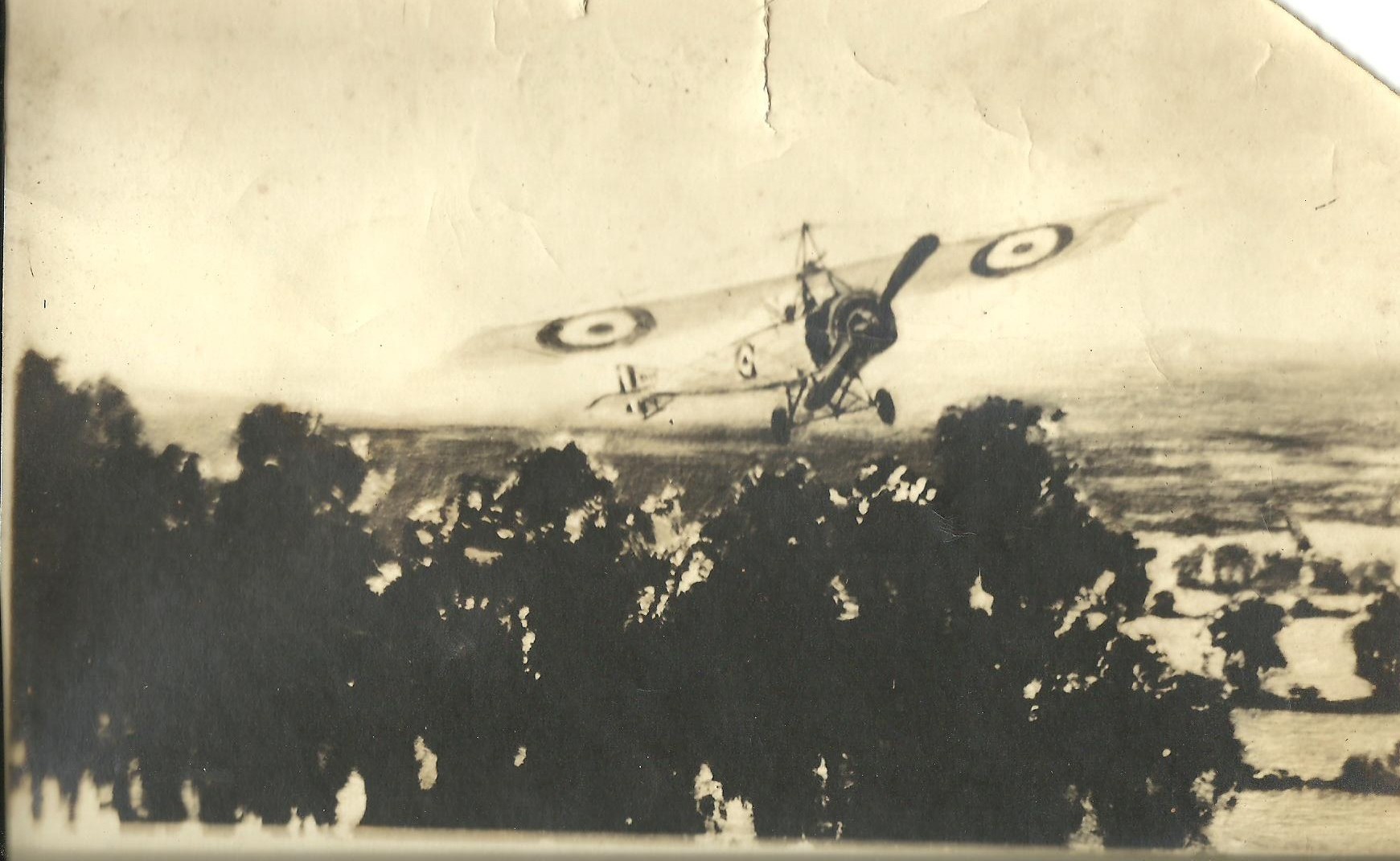
 Credited with 60 kills and 73 victories, ‘Mick’ Mannock’s plane burst into flames and fell behind German lines in World War One. There were only four months left until the end of the Great War. His body was never recovered, but his life is remembered by a memorial plaque at Canterbury Cathedral in England. A dance of tragedy and brute desire to survive; Mannock’s life symbolizes the struggle within us to make the most out of the life we are given.
Edward Mannock was the son of a Scottish corporal in the British Army who fought in the Boer War. After the war was over, Edward senior abandoned his family of four. Edward junior was relieved that the alcoholic and violent moods of his father would no longer be a part of regular family life. He and his brother were left to provide for the family. A higher education for the boys was no longer an option.
Mannock was twenty-seven when World War One broke out. Working in Turkey as a telephone engineer at the time, he attempted to return to England to enlist, but was imprisoned for eight months as an enemy of Germany. Close to death in prison, it was found prudent to send Mick home to England.
Once home he joined the British Army, but due to his health was considered unfit for military duties. Undaunted, Mannock joined the Royal Engineers, but found his calling in August 1916 when he transferred to the Royal Flying Corps.
A pilot and fighter on par with Billy Bishop and the Red Baron, it is believed that Mannock was almost blind in one eye- an amazing challenge for a fighting ace. As a commander of the 74 Squadron he was one of the world’s first theorists on aviation tactics.
But Mannock’s success in the air had its toll. Closer to the end of the war, he would have fits of shaking uncontrollably. He kept a pistol with him when he flew in case his plane was attacked and caught fire, he might be able to end his life with less pain than he witnessed on a daily basis. Parachutes were not allowed in the Royal Flying Corps, it was believed that it would encourage pilots to abandon their planes in battle.
Personal tragedy had followed his family. On leave in 1917 he visited his family, only to find that his mother had become an alcoholic like his father and his sister had become a prostitute. He confided to a close friend that he had wished to marry, but that never would.
 The only pictures of him are in monochrome, but portray a man with full lips, strong nose and high cheekbones-he is a handsome man. The last picture of him was found by accident in a French farmer’s photo album. His arm rests awkwardly on a young girl who stares intently at the camera. His eyes, while possibly squinting from the midday sun look sad- as if he has stumbled upon the photographer, or the photo was a request.
In 1919 Mannock’s father was presented with his son’s Victoria Cross and the other medals Mick had earned. They were promptly sold; a scandalous tribute for a young man and son who had sacrificed his life for his country.

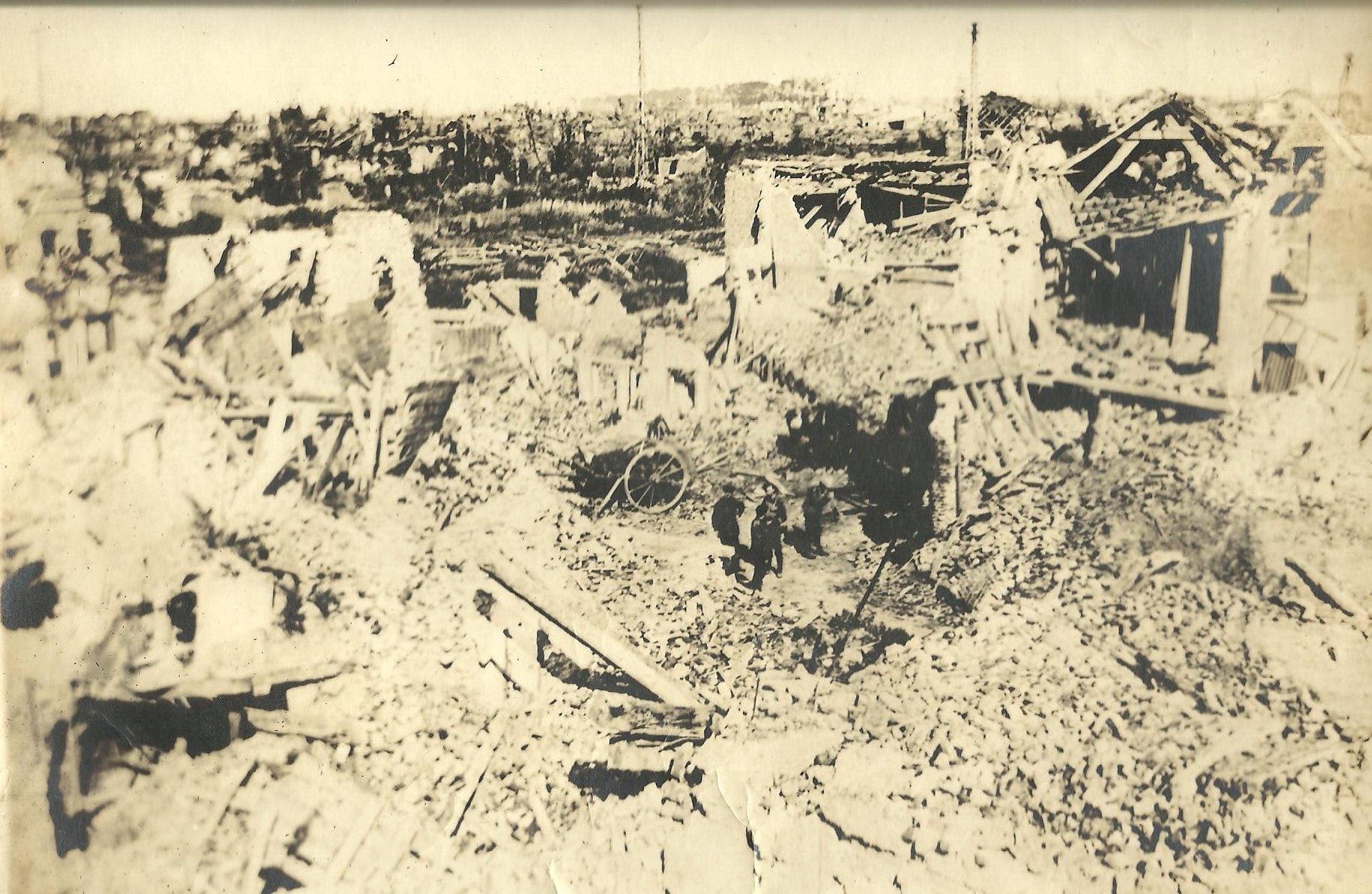
Writing on the back of the photo says ‘La Bassee.’ It was a battle in Northern France between Germany and British forces starting in October 1914. Germany occupied La Bassee, and the British attempts to regain the commune of La Bassee were futile that year.

 I went to see 3-D Brave with my five year old daughter yesterday. Since we are both curly red haired lassies, I thought the character would be someone that my daughter and I could relate to. I also am passionate about my Celtic heritage. It would be a nice change to find something in a Disney movie we could identify with rather than simply long for: such as long blonde hair, and a great singing voice.
Merida is the daughter of King Fergus and Queen Elinor of Scotland. Unlike her mother, she is only happy outdoors with her arrow and bow. Enter the conflict: Elinor thinks it is time that Merida marries (and if you haven’t seen the selection of young men that are offered, I can only tell you that I myself would demand to remain celibate).
Merida attempts to outwit her parents and the clans by vying for her own hand in marriage and challenging them to a competition of archery she knows she will win. Her success only adds to the rift between her and her mother, and culminates in Merida running away into the forest.
Forest spirits, or will-o-the-wisps, lead her to a witch who gives the young lass a potion that will change her mother. Merida believes that it will change her mind towards a forthcoming marriage. The reality is that it will physically transform her mother into a bear.
What follows is a humourous and touching journey to reverse the spell. Did I mention that King Fergus lost his leg to a bear, and that same evil bear is still lurking in the forest of the kingdom?
The shift turns at this point towards her mother’s struggle: being a bear and protecting her child. In the end her instinct to protect her child forces Elinor (the bear) to fight and defeat, the ancient evil bear (who was an ancient naughty king don’t you know, who broke the peace of the land).
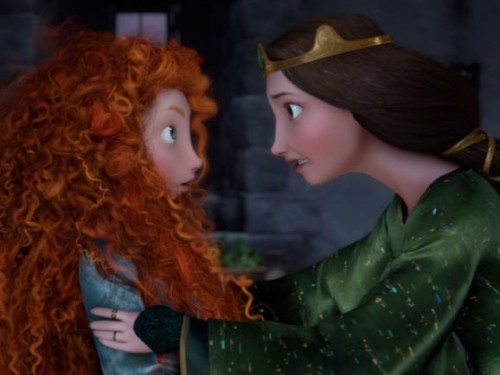 After this show down, Elinor returns to her human form but is transformed by her experience. Merida doesn’t have to marry, and mother and daughter have strengthened their bond.
In my minimal experience of Disney movies I see Brave breaking the usual Disney mold. We usually see a romantic relationship between characters even in the most recent of the Disney movies: Rapunzel and The Princess and the Frog. Whether they are initially looking for love or not- they find it. In most cases love is the final reward for most of the heroines of Disney.
Merida is not looking for love, but simply to enjoy life. She seems like a modern version of the huntress Diana. I wonder about the choice to make her suitors so unattractive. It allows her preference of chastity to be so simple (who would want to marry those men and welcome their crazy family into your clan). It would have been an interesting choice to have her suitors attractive, and still have her dislike the idea of marriage. It would have added more complexity and certainty to Merida’s choice.
Women are usually the antagonist of Disney movies: Cruella De Vil, Millicent, Snow White’s mother, Mother Gothel, And Cinderella’s step mother and sisters. In Brave, Queen Elinor starts out as the antagonist. She is the force that demands that Merida marry. Her role of antagonist ends there and she becomes a complex character through her transformation into a bear: she connects with her wild self, she fights to the death for her child (the bear fight did scare my daughter a little bit), and she realizes that tradition is less important than family.
The Celtic respect for the otherworld was honoured in this movie: the sense of the otherworld through the will-o-the-wisps, the standing stones, and the anthropomorphic change in Queen Elinor. The magic we observe in this movie is tied to the land, not simply the whim of any one character.
I would say that as far as Disney goes, Brave has strong female characters. A movie that would be enjoyed by mother and daughter alike- we certainly would go back.

 The pictures of the Island are nothing short of haunting. The buildings are in varying stages of decay. Their abandonment reflects the tragedy that clothes the island from first contact with civilization.

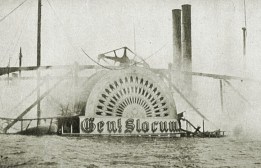
North Brother Island is part of New York State. In 1886 it was used as a quarantine hospital for patients with communicable diseases like small pox. Eighteen years later wreckage from the General Slocum, would wash up it its shore. A passenger steamboat taking Lutheran churchgoers to a picnic, the event tragically ended in fire on the water- and the death of 1, 021 of her passengers. It was considered one of the worst disasters in the United States before September 11, 2001.
A cottage on this 13 acre island was the home for one woman for 23 years. Her given name was Mary Mallon, but she is better known as Typhoid Mary. A cook by profession, she was the first known healthy carrier of typhoid- a severely infectious bacterial disease that causes a high fever, headache, intestinal hemorrhaging and sometimes death.
 As the first healthy carrier of this disease, the authorities didn’t know how manage Mary Mallon. She was discovered by George Soper, a civil engineer who specialized in typhoid. The trail of disease ridden bodies led to her kitchen. A strong willed woman, she fought him off with a knife. He would turn to a like-minded strong willed woman- Dr. S Josephine Baker who would capture Mary.
Mallon was held at North Brother Island for three years, believing she was a victim of an unjust law. Eventually the American people and a new health commissioner decided that Mallon should be freed as long as she pursued a new profession.
 She had seemingly succeeded until a maternity hospital was attacked by typhoid. The cook- a Mrs. Brown was discovered to be none other than Mary Mallon. Many thought her alias implied cruel intent, others realized that her name was well known and the profession of cook was the highest paying job for a poor Irish working woman. Unfortunately her choice of profession and location killed two hospital patients. Mallon was banished once again to North Brother Island for the next twenty-three years- until her death.
 After the passing of the most notable patient, the hospital was closed. The island was used for returning soldiers of World War Two going to school, and then again abandoned. The last attempt to breathe life into the island was as an addiction rehabilitation centre for teens in the 1950s. In the shadow of corruption and recidivism the centre was shut down and the island was left to the elements and ghosts of the past.
What stories the moss covered walls could tell….

 Brushed With Mystery