Book Review: The Forgotten Garden

Isn’t it strange that one place can both offer solace and be a prison? One certainly gets that sense reading of Blackhurst Manor and the cottage on the cliff that houses the secret garden: the namesake of Kate Morton’s book, ”The Forgotten Garden.”

The book begins when a little girl is left on a pier in Australia with only a suitcase full of items to tell the story of her origin.  She is taken in by a family that desperately wants a child. She is given the name Nell. It seems the ideal life: she has loving parents, brothers and sisters that love and idealize her and a fiancé that she loves and her father approves of.  But it is at this point that Nell’s father tells her about her origin, and rather than accepting the truth, Nell sees her whole past life as a lie and slowly tears the constructs of that life apart: breaks off the marriage, and turns away from her adoptive family.

This is the second book that I have read of Kate Morton, and I can certainly say I was not disappointed. Much like “The Distant Hours,” there is a strong sense of the Gothic novel in Morton’s work: the enchanted garden, the looming sense of evil at the Manor, and fairy tales. Her characters are romanticized, but she still has a way of making them complex and engaging.

We follow the life of four generations of women who are associated with Blackhurst Manor and the cottage on the cliff. The story slips from past to present with the suspense of a mystery novel.

Both past and present hold sway in Morton’s novels. A little girl Eliza, will be returned to Blackhurst Manor, the child of a sister who ran away from a diabolical brother. While it will seem as though she is saved from the streets of London after her mother dies, there are dark forces in the Manor that wish her ill.  This woman holds the key to Nell’s forgotten life.  It is only through her granddaughter Cassandra, that the real story of Nell and Elisa will be told.

The novel tackles challenging issues: love, need, loss, adoption, second chances.  Morton ties up the loose ends, and answers the questions that her story designs.

The book has encouraged me to see family in a continuum- not simply as one life, but the natural progression of many.  We are by far, a product of our past. Thank you Morton, I can’t wait to read the rest of your talented craftwork.

Posted in Book Review | Tagged , , | Leave a comment

Hitler: Sometimes Truth is Stranger than Fiction

As a history buff, anything in the news that is a new discovery with regard to history is a rare treat in the world of current stories.  I was amazed today to hear a report on Hitler and a potential child he might have.  My investigation of this story led me to another story about Hitler that is strange to say the least.

Hitler was a soldier in the First World War and was stationed in France.  One day in June 1917, he came across a group of French girls and decided to draw them.  One girl was elected to go and ask him what he was doing- this woman, Charlotte Lobjoie,  on her deathbed claimed that they had been lovers and that her son was Hitler’s child.

With only what I can find on the Internet as evidence, there does seem to be facts to substantiate her story:  Hitler kept in contact with Charlotte Lobjoie, the Wehrmacht brought her money during World War Two, her son does look a lot like Hitler, she had many of his sketches in her attic, and writing samples are amazingly similar to Hitler.

Her son, Jean-Marie Lore, seems to have suffered a great deal for this possible siring.  His mother gave him up for adoption, and being from a small town, he was constantly teased as a child for being a ‘child of the Bosh’.  He fought against Nazi Germany in World War Two, and joined the French resistance when France was taken by Germany.  The revelation on his biological mother’s deathbed must have been appalling.

He wrote a book in 1981 entitled, “Your Father’s Name was Hitler,” which seemingly was rejected by most historians and received little attention. The fact that it took him thirty years to write this story indicates some hesitancy on his part.  He died four years after the publication.

At least one person has disputed that Jean-Marie Lore, is Hitler’s child.  A Belgium journalist by the name of Jean-Paul Mulders, claims to have had DNA testing done on Lore’s children cross referenced with Hitler, and they are not the same.  Hopefully this mystery will be solved, if only to satiate people like me.

The second story?  The Nazi party on the eve of invading Russia investigated a Finnish man because of his dog Jackie.

It seems that the dog had an ability to raise it’s paw quite high.  The Finnish businessman, Tor Borg, was interrogated at the German embassy in Helsinki for insulting the Third Reich through his dog. It was claimed that his anti-Nazi wife Josefine, had nicknamed the dog ‘Hitler,’ due to its ability to raise it’s paw like the hailing signal of the Nazi party.  Borg was interrogated for three months, and the Nazi party attempted to ruin his company, but in the end was unsuccessful.  Sometimes truth is stranger than fiction.

Sources:

http://news.nationalpost.com/2012/02/17/is-jean-marie-loret-hitlers-long-lost-son/

http://en.wikipedia.org/wiki/Jackie_%28dog%29

http://www.bbc.co.uk/news/world-europe-12139150

http://www.telegraph.co.uk/news/worldnews/europe/france/9088865/Hitler-had-son-with-French-teen.html

Posted in historical, World War One, World War Two | Tagged , , | 3 Comments

World War One Photo: Noyon

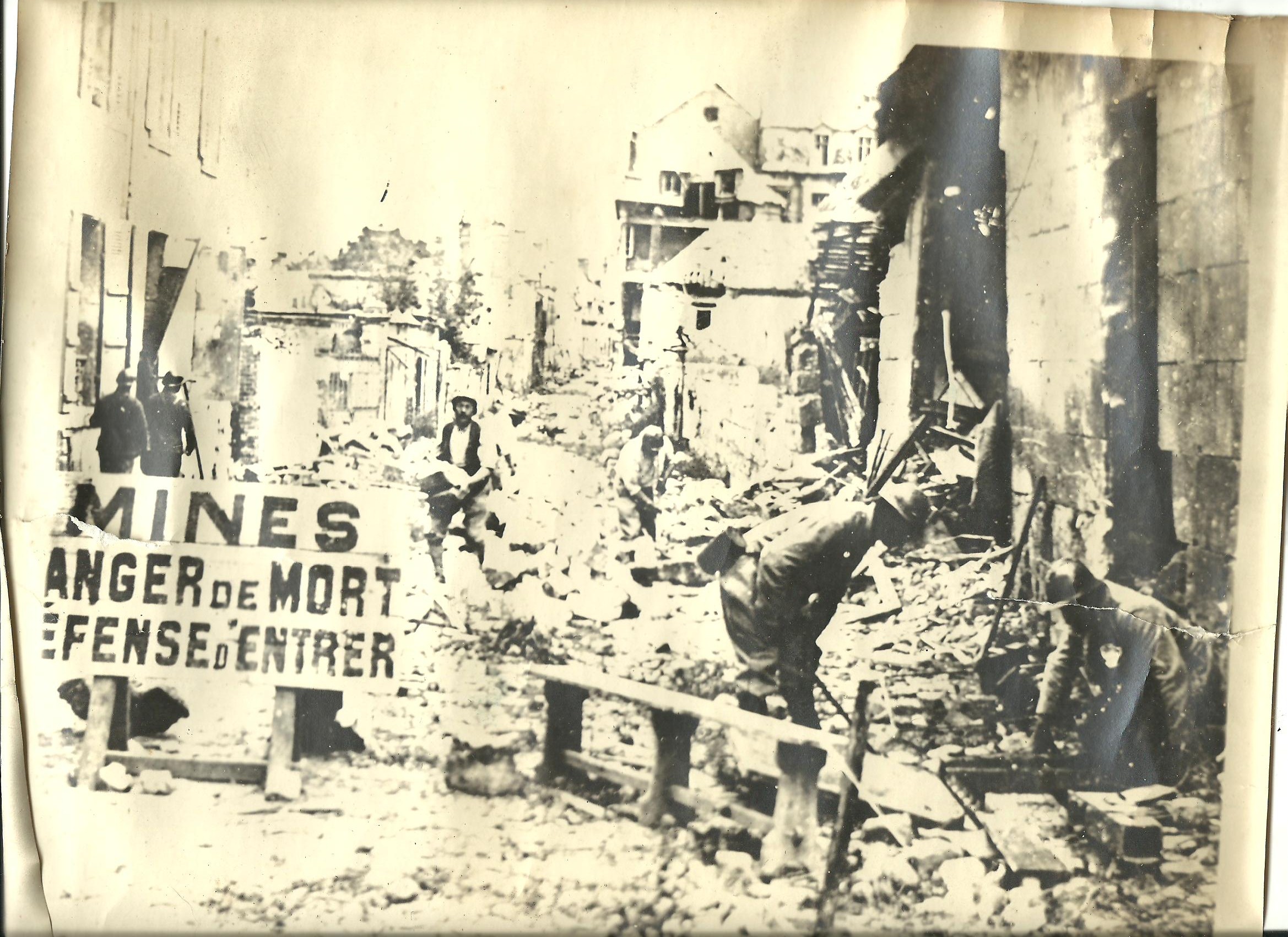
I almost lost the trail on this photo. The name is written so badly on the back (sorry great-granddad) that I almost gave up.  I originally thought it said ‘Lyon,’ and then ‘Nayon’.

Now that I have found the accurate name, I have found a myriad of resources that I would love to research.  There are quite a few of you that look here for new resources, and I don’t want to delay in sharing something to whet your appetite.

Noyon was captured by the Germans in 1914, and held until 1918, when the Allies recaptured it. Most of the sources I have found are primary resources: diaries and letters-  they are amazing in their own detail.  I could spend weeks just researching them to get a better feel of the location and the people that lived- and died there.

There is one, and possibly two resources I would love to share: one is an account from 1918, written by Dr. F. O. Taylor  of the RAF, who claims that having survived through the extent of the war, the time spent in this location was the worst experience.  He writes in 1918:

I stopped about 50 yards from the gate to talk to a group of our men, noticed the colonel talking to two or three other officers in the centre of the macadamised space, and was admiring the pretty aeroplane – the first British ‘plane we had seen for days – glittering in the sun, the red-white-and-blue rings clearly visible, when there came an indescribable explosion.

It was the most terrific, though not the loudest, perhaps, that I have ever heard, followed immediately by dull thuds and the sickening sight of men falling, groaning, spouting blood – whole limbs severed, horses frantically breaking loose.

But in the moment of frightful surprise I could only grasp the fact that two more explosions followed, luckily outside the gate, and believing that a Boche long-range gun had found us, I waited a few seconds flat on the ground for more – but no more came.

Beside me was one of the youngest men in the ambulances; the calf of one of his legs was torn right out, and the wound was spouting blood.  I dragged him into the nearest hut and compressed his femoral artery, managing to stop the bleeding.

The hut seemed full of frightfully wounded men; I could do nothing but hang on to my poor little private’s artery.  What terrible faces they all had, pale as ashes!  “Water,” they groaned.  “Oh, sir, can you do nothing for me?”  It was frightful.

Source: http://www.firstworldwar.com/diaries/noyon.htm

Posted in historical, primary resource, World War One | Tagged , , | 2 Comments

Eleanor of Gloucester: Witchcraft at Court

The year he captures is 1441- the painter is Edwin Austin Abbey.  The figure is Eleanor of Gloucester, she is doing penance for necromancy and witchcraft.  I read her name in a book about Anne Bolelyn by Allison Weir.  Both women held power incumbent on their ability of conceive, and both fell tragically.

She was not the first to marry Humphrey,  she was the lady- in- waiting  to his first wife, Jacqueline of Wittelsbach . Incidentally, why is it that while the term lady- in- waiting is used to mean a personal attendant to a noble woman, it can also be used to indicate that the attendant is a lady waiting to be the next head of the household? Certainly this is true of Anne Boleyn and Eleanor of Gloucester.

Eleanor married Humphrey of Gloucester in 1428. She was in her late twenties, and he was closer to forty.  He had to annul the marriage with Jacqueline first. While the challenges of Henry VII would indicate that divorce or annulment was hard to achieve,  the vast array of nobles marrying  several times in one life would indicate the contrary (Jaqueline had two marriages of four annulled).  Humphrey is known to have sired only two children that were not specifically named as Eleanor’s.  Whether this is the triumph of detractors is unknown.   The one certain fact is that Eleanor fell from her high position; on top of her public penance(shaming)  that is displayed by Mr. Abbey, was the command that she divorce her husband.  Her children might have wished to distance themselves from such a mother.

What was her crime? Witchcraft and necromancy. Her opponents wanted her tried for treason, but that she would not allow. Her husband, Humphrey of Gloucester, was brother of Henry V and uncle to Henry VI, for all purposes a powerful man.

The history books paint Humphrey as a humanist, a lover of language, art, poetry and knowledge.  Their court was alive with ideas that scanned the earth and the heavens. Being close to the king, and in a position of power, every action is watched and assessed.

Four people were implicated with Eleanor: Margery Jourdemayne  was known as a woman who could help with  issues of love. In modern day she might be seen as a doctor, but in 1430 her potions and images warranted her the title of witch.   Roger Bolingbroke was an Oxford scholar adept in astronomy, and his colleague in Humphrey’s house was Thomas Southwell, who was a physician and a cannon. John Hume was a secretary and chaplain to the family.

How often Eleanor was informed on her horoscope is uncertain, but part of her fortune warned that Henry VI would die.  This was the axe that would end the life she had spent much of her time creating. Whether she asked or not, the reality was that the answer came from astrology, and witchy craft- made all the worse that the named to die was the head of the country, and her husband was next in line to the throne.

Eleanor was finally tried in 1441, by a ecclesiastical council, she vehemently denied doing anything treasonous.  Her association with Margery  Jourdemayne, she pleaded was simply  to have assistance in conceiving a child by Humphrey. Margery, for her relationship with Eleanor on this offence, and her continued practise of the dark arts, was burned to death on October 27, 1414. Roger Bolingbroke, who might have been the original soothsayer regarding the king was tried for treason.   He was hung drawn and quartered at Tyburn gallows and his head was displayed on London Bridge.  Thomas Southwell, a physician by profession, died in prison, possibly by his own hand. Hume was pardoned- his family was nobility after all, the disenfranchised are usually the ones to die.

Eleanor would go on to live until 1454.  Humphrey and his only son died in 1447. Did they ever write? Was their distance and estrangement forced? Did he believe her to be guilty of the charges, or did he know that it was simply the law of power to destroy opposition?  Was he killed? History doesn’t give up their secrets. It is left to the storytellers to imagine the rest.


Posted in history and literature, Thoughts | Tagged , , , , | Leave a comment

Afternoon Tea-A Brief Story

“We don’t talk of him” her eyes returned to her sewing.  Only a slight pause in the stitch indicated that the question was unexpected and painful. There was an exchange of glances between the two other ladies, each taking a sip of the proffered weak tea before they too returned to their sewing.

There was talk in town, of an unexpected visit to Helen MacDonald.  The war made everyone desperate for any kind of information that wasn’t written in the paper.  Families with soldiers or politicians were invited to more events and to more teas- always with the hope of more information that was given in the papers.  Letters said nothing of details, but offered the most important information- we are still alive.  At least up until the last two weeks (or more) of the letter.

The fact that Mrs. MacDonald wouldn’t speak of her son made her friends think the worst. Was he wounded, mutilated or dead? Before the war, when life was blissfully normal, her friends would roll their eyes at their friend’s boasting during Saturday tea; “Have I told you where Tommy is going for University?”

They didn’t mind .  The three of them had grown up together: played dolls, went to dances, fell in love, got married, had babies, and now the war.  It’s not as though they hadn’t been touched by the war  themselves- Haddie’s daughter lost her fiancée in the war, and Beatrice’s son couldn’t join because he was flat footed. God knows the family had been ridiculed by his inability to join.  Certainly his father had borne it poorly- he was almost unable to speak to the boy without looking away. It had made a boy that was joyful and carefree quiet and brooding.  Yes, this war was changing people.

And now Helen wasn’t speaking.  The thoughts of her companions hovered in the room united in the vastness of the comfortable past and the painful present. They resolved themselves to be present if Helen should speak.  Part of them was afraid that she would, possibly shattering more of the remnants of a life and community that was once intact.

The hours ticked away.  Socks were stitched and a blanket started for the boys overseas.  The talk was brief , pregnant with what might be spoken. But somehow even without speaking, without sharing in words , their space in the room eased the pain of the present.

It was Haddie that spoke first. Excusing herself.  Her daughter would be expecting her home for dinner. The ladies stood.  Helen, avoiding eye contact with her friends returned with their coats.  While it was agony to be together- words unspoken, it was harder to part.

It was the parting words- the good-byes that did it.  She wasn’t intending to look them in the eye. She had done this so many times with them, just in this way, but something had changed- her world.

They knew- how could they not.   It was only at the last moment, just as they were going to walk out the door.  She looked at them and they couldn’t help but know- her lips quivered and her eyes filled with unquenchable pain.  Without missing a beat they encircled her spreading their arms around her- a protective cocoon fashioned on thirty years of friendship. They simply held her as she screamed.

Posted in 1900-1914, Short Story, World War One | Tagged , , | 4 Comments